
On 16 November 2026 a US federal court vacated the F-1 duration of status rule that the Department of Homeland Security (DHS) published in July, so international students will not be moved to a fixed admission period of up to four years. Judge F. Dennis Saylor IV of the US District Court for the District of Massachusetts set the rule aside in full. A day later, Judge Julia E. Kobick of the same court stopped the Student and Exchange Visitor Program (SEVP) from enforcing its August 2026 guidance that had narrowed Curricular Practical Training (CPT). For Indian students preparing applications for Fall 2027, and for the parents funding those degrees, the system that has governed F-1 stays for decades remains in place. This post explains what the rule would have changed, what the two courts decided, what the government can still do on appeal, and how to plan a US application in the months ahead.
Key Takeaways
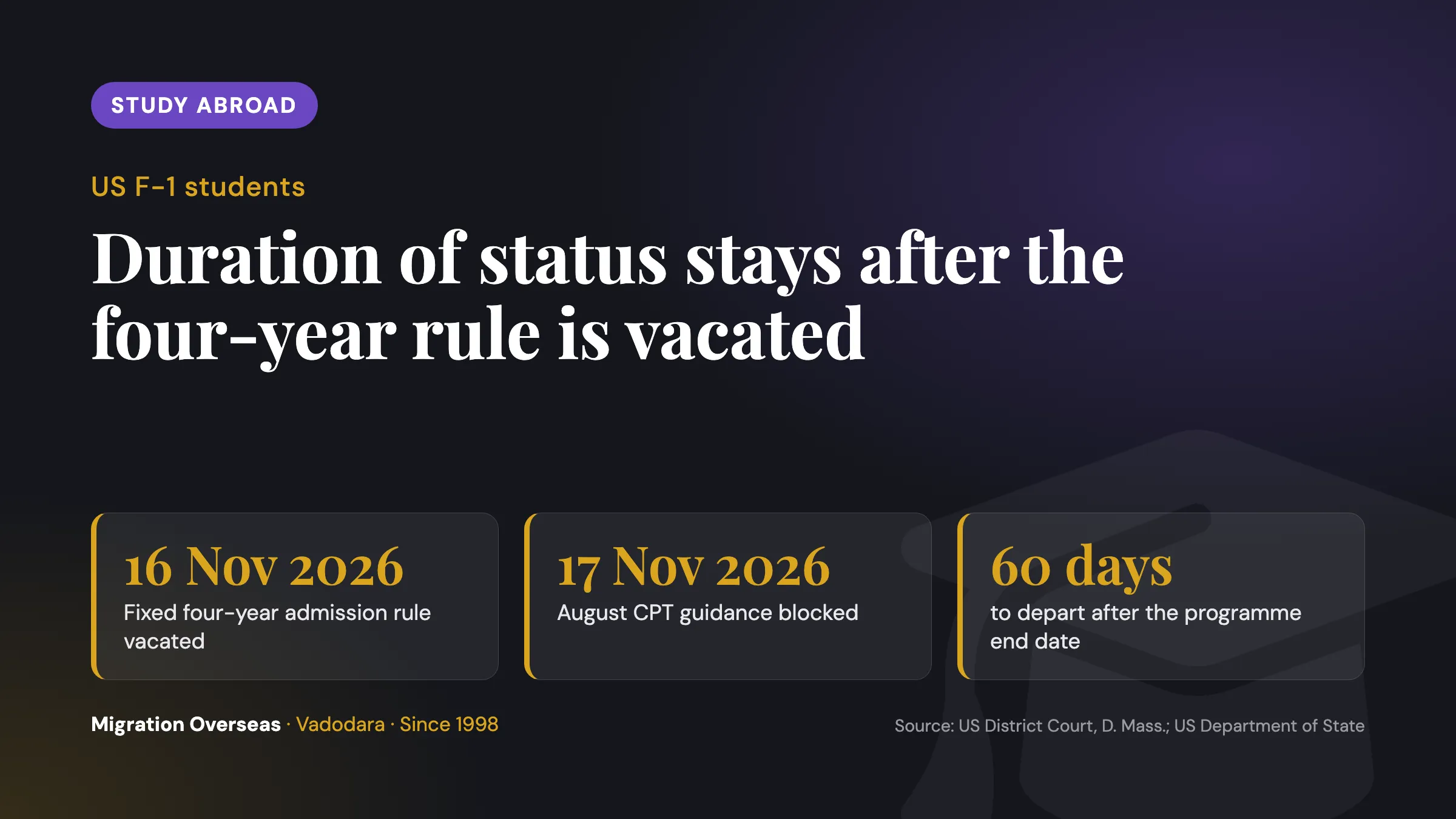
- Rule vacated: the DHS final rule of 17 July 2026 (91 FR 44976), which would have capped F and J admission at four years, was vacated on 16 November 2026 and never took effect.
- Duration of status continues: an F-1 student stays in status while pursuing a full course of study, and has 60 days to leave after the programme end date on the I-20, including any authorised practical training.
- CPT guidance blocked: on 17 November 2026 the court ordered that SEVP's broadcast messages of 12 and 24 August 2026 may not be enforced or applied while that case continues.
- Not final yet: DHS had already appealed the earlier September order to the First Circuit and can seek review of the final judgment. Watch for updates before you travel.
- Your 2027 plan: nothing in these rulings changes how you get an I-20, pay the USD 350 SEVIS fee or book a visa interview.
What Duration of Status Means for an F-1 Student
Most US visa categories give you a fixed date on your I-94 record, and you must leave or extend before it. F-1 students have long been treated differently. Their I-94 shows "D/S", short for duration of status. Under the regulation at 8 CFR 214.2(f)(5)(i), that period covers the whole time you are pursuing a full course of study at a school certified by SEVP, and it stretches across any authorised practical training after your programme.
In practice, your permission to stay is tied to your I-20 and your conduct rather than to a calendar date. If your Master's runs two years, then you take a year of OPT, and then a STEM OPT extension, you remain in status throughout, provided you follow the rules on enrolment, reporting and employment. The State Department explains that once your programme end date, including practical training, has passed, you must leave the US within 60 days.
This flexibility matters to Indian students in particular. Many move from a Master's into a PhD, change schools after the first year, or add a second degree. Under duration of status, those moves are handled by the school's Designated School Official (DSO) through SEVIS, not by a separate government application with its own fee and waiting time.
What the July 2026 DHS Rule Would Have Changed
DHS published its final rule on 17 July 2026 under the title "Establishing a Fixed Time Period of Admission and an Extension of Stay Procedure" for students, exchange visitors and foreign media representatives. It was due to take effect on 15 September 2026. In the court's description, the main changes were:
- A fixed end date: F and J students would be admitted for the length of their programme, capped at four years, instead of for duration of status.
- Extension applications: anyone needing more time, for example a PhD student or someone whose degree ran late, would have had to request an extension of stay from DHS on Form I-539.
- Less mobility: the rule restricted changes of educational objective, school transfers and moving on to a further programme. The court later found these limits inconsistent with the purpose of the F-1 category in the immigration statute.
- A shorter exit window: the proposal behind the rule would have reduced the 60-day departure period after studies to 30 days.
For a typical Indian student on a two-year Master's, a four-year cap might not have bitten at once. The risk sat with longer paths: a four-year Bachelor's that runs a semester late, a Master's followed by a PhD, or a student who changes programme. Each of those would have meant an extra filing, an extra fee and a period of uncertainty while a decision was pending.
What the Court Decided on 16 November 2026
The challenge was brought by the Presidents' Alliance on Higher Education and Immigration and others against DHS (case 1:26-cv-13799). On 14 September 2026, one day before the effective date, Judge Saylor postponed the rule under section 705 of the Administrative Procedure Act while the case was decided. That is why the four-year cap never applied to anyone.
On 16 November the court granted the plaintiffs' motion for summary judgment, denied the government's motion, and vacated the rule under section 706 of the same Act. The court relied on the reasons it had given in September: DHS had not properly weighed the costs and benefits, had not supported its fraud and national security justifications, had not considered less burdensome options and had not answered public comments adequately. It added that DHS had failed to consider making better use of the existing SEVIS system, and that the limits on academic mobility were contrary to the statute that defines the F-1 category.
DHS had asked the court to send the rule back for revision while leaving it in force. The judge declined, noting that the current system has run for decades and the rule had never operated, and directed the clerk to enter final judgment for the plaintiffs.
The Separate CPT Ruling of 17 November
Curricular Practical Training lets an F-1 student work, often in a paid internship, when the work forms part of the degree. For many Indian Master's students in engineering, data and business programmes, a summer internship through CPT is the main route to US work experience before graduation.
In August 2026 SEVP sent two broadcast messages to schools, dated 12 and 24 August. They told DSOs to authorise CPT only where the practical training is required of every student in the degree, which in effect ruled out elective, for-credit internships. In Association of American Universities v. DHS (case 1:26-cv-14520), Judge Kobick held that the plaintiffs were likely to succeed in showing that SEVP had abandoned its long-standing position without acknowledging the change. She granted a stay and a preliminary injunction, and ordered that the two messages may not be enforced or applied while the case continues.
Two limits matter. This is a preliminary ruling, not a final judgment. The court also did not decide what the regulation's phrase "integral part of an established curriculum" ultimately means. CPT is again available on the terms schools used before August, but each school still applies the regulation, and you should read your university's own CPT policy rather than assume every internship qualifies.
What is still uncertain
DHS appealed the September order to the US Court of Appeals for the First Circuit, and that appeal was pending when the November judgment was issued. The government can also seek review of the final judgment, and DHS could start a new rulemaking. An appeal on its own does not bring the rule back, but a later decision could change the position for future students. Treat duration of status as the rule today, and check your school's international office and official DHS notices before each trip.
F-1 Duration of Status Rule and Your Fall 2027 Plan
The good news for families in Gujarat planning an August or September 2027 start is that the application process itself does not change. You still need admission from a SEVP-certified school, a Form I-20, the I-901 SEVIS fee, the DS-160 online form and a visa interview. ICE lists the SEVIS fee for F and M applicants at USD 350, paid before the interview.
The State Department allows a student visa to be issued up to 365 days before your course start date, but you cannot enter the US on that visa more than 30 days before the start date on your I-20. Interviews are generally required for applicants aged 14 to 79. Book as soon as your I-20 arrives rather than waiting for your other offers to settle, so that a slow appointment calendar does not squeeze your travel dates.
What does change is your planning horizon. With duration of status intact, a Master's followed by OPT, a STEM OPT extension or a move into a PhD is again a single continuous stay managed through your school. You do not need to budget for an extension application at the four-year mark. You should still keep every I-20 and SEVIS record clean, because an unauthorised gap or an enrolment problem ends status whatever the admission system is.
If you are already in the US
- Your I-94 should continue to show D/S. If a new entry record shows a fixed date, raise it with your DSO straight away.
- Plan programme changes and transfers with your DSO in the usual way, keeping to SEVIS deadlines.
- If you were told in September or October that an elective internship could not count as CPT, ask your international office whether it can now be reconsidered under the school's pre-August policy.
For Students and Parents in India
The questions we hear from Vadodara and Ahmedabad families this month are practical ones: whether the US is still worth applying to for 2027, and whether these court rulings make the visa easier. The rulings protect the length and flexibility of your stay once you are in the US. They do not change how a consular officer decides your visa.
An F-1 interview still turns on the same points. The officer looks for a real academic plan, funds that match the costs printed on your I-20, and an explanation of why this course at this university makes sense for your background. The documents Indian applicants most often trip on are these:
- Funds that do not trace back: large deposits made shortly before the interview without a clear source. Keep the paper trail for education loans, fixed deposits and property sales.
- A sponsor who cannot explain the plan: parents who pay should know the university, the course and the yearly cost shown on the I-20.
- A study plan that does not fit: a gap or a change of field without a credible reason. Our SOP writing guide covers how to explain this in writing.
- Mismatched details: names, dates and marks that differ between the DS-160, the I-20 and your marksheets. Our student visa document checklist lists what to carry.
Costs vary widely by university and city, so take the figures from each I-20 rather than from averages online. The SEVIS fee of USD 350 and the visa application fee are paid once per application, and the State Department fee page gives the current visa fee.
Our Reading
This is a real win for international students, and it removes the biggest structural worry that Indian families raised about the US over the past four months: the fear that a child could finish a Master's and then face an extension application before starting OPT or a PhD. The court's language on remand was firm, and an appeal does not reinstate the rule automatically. I would not change a 2027 application plan because of the appeal risk alone.
I would be careful about two things. First, the CPT ruling is preliminary. Students choosing between universities partly on internship prospects should look at programmes where practical training is a required part of the curriculum, because that position is safe under either reading of the regulation. Second, none of this affects visa scrutiny at the consulate. A clean, well-funded, coherent file still matters more than any court ruling.
Who should apply for 2027: students with a clear academic reason for their chosen course and funding that matches the I-20, especially in STEM fields where OPT and STEM OPT give a longer period of practical training. Who should think harder: students relying on CPT income to pay fees, or families stretching to show funds. If the US budget is tight, compare it honestly with other countries using our study destination comparison.
Your Action Checklist
Keep your Fall 2027 timeline
Finish university applications and test scores on schedule. The rulings do not move any admission or visa deadline.
Check each programme's CPT policy
Ask the international office whether internships are required or elective in your course, and how they authorise CPT now.
Build a funds file that traces back
Match loan sanctions, deposits and sponsor income to the cost on your I-20, with the source of every large amount documented.
Pay SEVIS and book the interview early
Pay the USD 350 I-901 fee and book as soon as the I-20 arrives. A visa can be issued up to 365 days before your course starts.
Watch for appeal news before travel
Check your school's updates and official DHS notices before you fly, and again before any trip home during your studies.
Planning a US degree for Fall 2027?
Our team in Vadodara reviews F-1 files for students across Gujarat: course choice, funds and sponsor documents, the statement of purpose and interview practice. See our F-1 student visa page for the full process.
Visa Interview PreparationFrequently Asked Questions
Is duration of status still in place for F-1 students?
Yes. The DHS rule that would have replaced duration of status with a fixed admission period was postponed on 14 September 2026 and vacated on 16 November 2026, so it never took effect. F-1 students remain in status while they pursue a full course of study and any authorised practical training.
What was the four-year rule for F-1 students?
It was a DHS final rule published on 17 July 2026 that would have admitted F and J students for the length of their programme, up to four years, and required an extension of stay on Form I-539 for anyone needing longer. It also restricted transfers and changes of programme.
Can DHS appeal the duration of status ruling?
Yes. DHS had already appealed the September order to the First Circuit, and it can seek review of the November final judgment. An appeal does not reinstate the rule by itself, but a later appellate decision or a new rule could change the position.
Is CPT allowed again for elective internships?
For now, yes, on the terms schools used before August 2026. On 17 November 2026 the court ordered that SEVP's August broadcast messages may not be enforced or applied while the case continues. Each school still decides whether a particular internship meets the CPT regulation.
Does this ruling affect OPT or STEM OPT?
OPT and STEM OPT continue under the existing regulations. Because duration of status remains, you stay in status through authorised practical training, and the 60-day departure period starts after the programme end date including that training.
How long can an F-1 student stay after finishing a course?
The State Department says F students must depart within 60 days after the programme end date on the I-20, including any authorised practical training.
Does the court ruling make the F-1 visa easier to get from India?
No. The rulings concern how long students may stay and what training they may do once in the US. Visa decisions at US consulates in India still depend on your study plan, your funds and your ties, assessed at the interview.
What is the SEVIS fee for an F-1 visa?
ICE lists the I-901 SEVIS fee for F and M applicants at USD 350. It is paid before the visa interview and is separate from the visa application fee.
Official sources
This article is based on the US District Court for the District of Massachusetts Memorandum and Order on Cross-Motions for Summary Judgment of 16 November 2026 and its Memorandum and Order on Motion for Preliminary Injunction of 14 September 2026 (Presidents' Alliance v. DHS, published on GovInfo); the court's Memorandum and Order of 17 November 2026 in Association of American Universities v. DHS (copy of the court order published by the plaintiffs); the Federal Register notice of the final rule (17 July 2026); 8 CFR 214.2; the US Department of State student visa page and visa fees page; and ICE's I-901 SEVIS fee page. All were checked on 24 November 2026. It is general information, not legal advice.