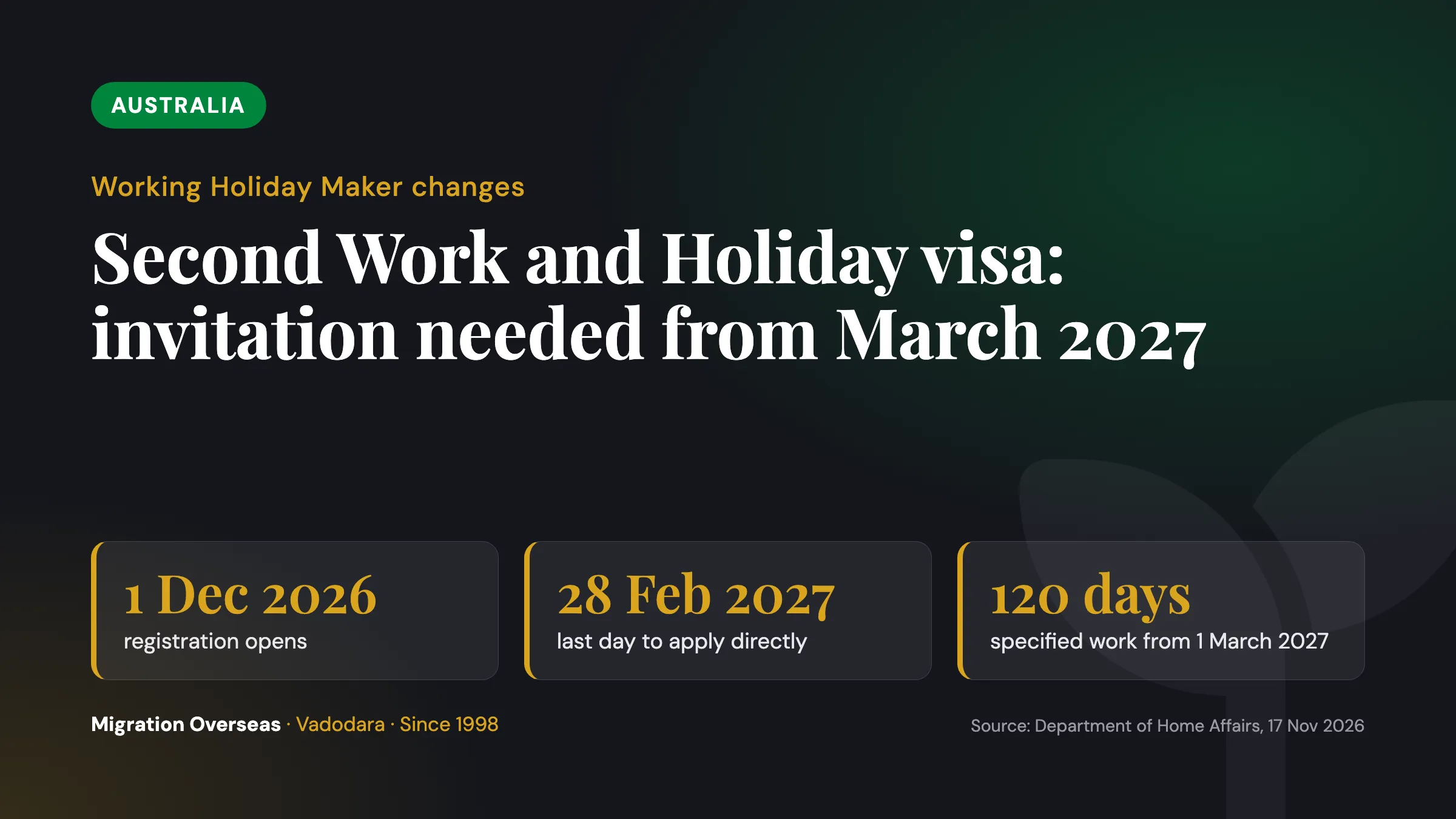
Indian passport holders on a first Work and Holiday visa in Australia now face a deadline that decides how they get a second one. On 17 November 2026 the Department of Home Affairs announced that, from 1 March 2027, anyone wanting a second Work and Holiday visa (subclass 462) or a second or third Working Holiday visa (subclass 417) must first register, be invited and complete their specified work before applying. Registration opens on 1 December 2026, the first invitations are expected in mid-January 2027, and the specified work needed for a second visa rises from 88 days to 120 days. Applicants who finish their work and lodge a valid application by 28 February 2027 can still apply directly under the old process. Young Indians who were selected in an earlier 462 ballot and are now in Australia are the group this affects most, and the choice they make over the next three months will shape the rest of their time there.
Key Takeaways
- New gate: from 1 March 2027 you need an invitation before you can apply for a second or third Work and Holiday visa. Registration opens on 1 December 2026 and you can register before your specified work is done.
- More work: the second-visa requirement goes from 88 days to 120 days of specified work from 1 March 2027. Days you have already worked still count. The third-visa requirement of 179 days does not change.
- Transitional route: finish your specified work and lodge a valid application by 28 February 2027 and you can apply directly, without registering.
- No guarantee: registering does not mean you will be selected, an invitation does not extend your current visa, and anyone not selected must leave before their visa ends.
- India is covered: India is on the list of countries eligible for a second 462 visa, and the announcement exempts only UK passport holders.
What Home Affairs Announced on 17 November
Until now, a Working Holiday Maker who completed the required regional or industry work could simply lodge an application for the next visa in ImmiAccount. That direct route is closing. Home Affairs is placing a registration and selection step in front of second and third visas for both the 417 and 462 programs, and attaching what it calls a Next Year Regional Work Guarantee to each invitation. In plain terms, the invitation is your permission to apply for the following year's visa once you have met every other requirement, including the specified work.
The department has not published how many people it will invite in each round or how selection will be made beyond saying that registration does not guarantee selection. Its separate page on country caps still states that second and third Work and Holiday visas have no annual cap, which is a different thing from saying everyone who registers will be invited. Until the first round runs in January, nobody outside the department knows how generous the rounds will be.
Second Work and Holiday Visa Rules From 1 March 2027
The new process runs in four stages. You register your interest, you wait for an invitation round, you complete the specified work, and then you lodge the visa application. Home Affairs says registration can happen before the work is finished, so there is no reason to wait for your last shift before signing up.
Registration
Registration opens on 1 December 2026 and you can register from inside or outside Australia. The department has said it will publish the steps on its Working Holiday Maker news page before that date. Its process diagram adds that registrations stay valid only until 30 June each year, so someone who is not selected by then has to register again from 1 July to stay in later rounds.
Invitation
The first round is expected in mid-January 2027, and the diagram indicates that rounds will then run monthly. An invitation gives you 12 months to lodge a valid application, provided you meet all the eligibility requirements at that point. It does not extend the visa you hold today. If your first visa is ending and you have not been selected, Home Affairs is clear that you must leave Australia before it expires.
Specified work
For a second visa the minimum rises from 88 days to 120 days on 1 March 2027. Eligible work completed before that date still counts towards the new total, so nothing you have already done is lost. The third-visa requirement stays at six months, which Home Affairs counts as 179 calendar days.
Application
Once invited and with the work complete, you apply in ImmiAccount as before. If you lodge in Australia, the department may grant a bridging visa while your application is processed. Home Affairs says it is normalising Working Holiday Maker processing to an average of about three months, so do not book flights or commit to a job that depends on the new visa until it is granted.
| Your situation | Which process applies | Specified work needed for a second visa |
|---|---|---|
| Work complete and valid application lodged by 28 February 2027 | Transitional: apply directly, no registration | 88 days |
| Work not complete by 28 February 2027 | Register, be invited, then apply | 120 days |
| Work complete but application not lodged by 28 February 2027 | Register, be invited, then apply | 120 days |
| Applying for a third visa after 28 February 2027 | Register, be invited, then apply | 179 days (unchanged) |
The third row is the one people will get wrong. Having 88 days on your payslips by February is not enough on its own. The application has to be lodged and valid by 28 February 2027, which means the fee paid and the form complete, or you fall into the new process and the higher threshold.
What Counts as Specified Work for a 462 Visa
This is where Indian 462 holders need to be most careful, because the rules for the 462 are narrower than many people assume from what they hear about the 417. Specified work is paid work in an approved industry carried out in an approved postcode. Both conditions must be met. For the 462, the approved combinations are:
| Industry | Where it counts for a 462 |
|---|---|
| Tourism and hospitality (hotels, hostels, cafes, restaurants, bars, tour operators) | Northern Australia, or areas classed as Remote and Very Remote, plus four listed postcodes in Queensland and Tasmania |
| Plant and animal cultivation (harvesting and packing fruit and vegetables, pruning commercial crops, dairy, livestock) | Northern Australia and the listed regional postcodes |
| Construction | Northern Australia and the listed regional postcodes |
| Fishing and pearling; tree farming and felling | Northern Australia only |
| Bushfire and natural disaster recovery work, paid or volunteer | Declared affected postcodes |
The practical consequence: a cafe job in central Melbourne, Sydney or Brisbane does not count towards a second 462, however many hours you work. The same job in Darwin does, because every Northern Territory postcode is in the northern list, and so does hospitality work in the listed far north Queensland postcodes. Fruit picking and packing in regional Victoria, regional New South Wales or anywhere in South Australia or Tasmania can count, because those areas are on the regional list for cultivation and construction. Always check the exact postcode against the Home Affairs table before you accept the job, not after.
How the days are counted
- Full-time equivalent: you must work the same number of normal days or shifts a full-time worker in that role would work over the period. Two days a week for three months is not three months of specified work.
- Spread is allowed: the work can be split across several employers and several stints, as long as it adds up and is done while you hold the previous visa.
- One day is one day: a double shift on a single calendar day still counts as one day.
- Paid leave counts, unpaid days do not: paid public holidays and paid sick days count. Days lost to rain or heat without pay do not, and Home Affairs makes no exception for bad weather.
- Lawful pay only: all specified work must be paid under Australian law and the relevant award, including piece-rate work under a written agreement.
You will need evidence covering every period you claim: payslips, Australian bank statements showing the wages, a piece-rate agreement if you were paid per bin or per kilo, payment summaries or tax returns, and employer references. The department says it may contact employers to check.
Applying From India: Eligibility and Costs
India appears on the Home Affairs list of passports that qualify for a second 462, so Indian first-visa holders are inside the new process rather than outside it. The other second-visa requirements are unchanged:
- you must have entered Australia on your first 462 and complied with its conditions;
- you must be aged between 18 and 30 inclusive at the time of applying, with the deadline at midnight Australian Eastern time on the day before your 31st birthday, even if you are applying from India;
- you need funds to cover your stay and your departure, which Home Affairs puts at about AUD 5,000 plus your onward fare;
- you cannot include family members or be accompanied by dependent children;
- if you are in Australia, you must hold a substantive visa or have held one that expired less than 28 days earlier.
The age rule matters more now. An invitation gives 12 months to apply, but it does not move your 31st birthday. Anyone who turns 31 in 2027 should plan around the birthday first and the invitation second.
Costs to plan for
The first Work and Holiday visa charge is AUD 840, and Home Affairs points applicants to its Visa Pricing Estimator for the current second-visa charge. Add possible health checks, police certificates and biometrics. At an assumed rate of INR 55 to 60 to the Australian dollar (check the day's rate), the AUD 5,000 funds benchmark works out to roughly INR 2.75 lakh to INR 3 lakh. Families in Gujarat supporting a son or daughter on a 462 should also budget for the move to a regional or northern area: rent and transport in Darwin or a harvest town are a real cost, and the first weeks of a harvest job often pay less than expected while you learn the work.
Where applicants from India trip up
- Metro hospitality jobs. A frequent misunderstanding: months of cafe or restaurant work in a capital city that does not count for a 462.
- Cash pay with no records. Wages paid in cash, without payslips or bank deposits, are very hard to prove. Insist on payslips from the first week.
- Paying for days. Never pay anyone for a job that comes with "signed off" days or for a reference letter. Home Affairs checks employers, and false documents can lead to refusal and to findings that affect every future Australian visa application.
- The six-month employer limit. Condition 8547 generally stops you working more than six months for one employer, so a long harvest contract with a single farm may need planning.
- Assuming a visitor visa as a fallback. Home Affairs says it generally does not grant a visitor visa after a Work and Holiday visa where it would take you past 12 consecutive months in Australia, unless there are exceptional circumstances. Our post on the visitor no further stay condition explains the wider tightening.
Our Reading
For an Indian 462 holder already in Australia with regional work under way, the transitional window is the most valuable thing in this announcement. If you can reach 88 eligible days and lodge a valid application by 28 February 2027, you avoid both the invitation step and the extra 32 days of work. That is worth rearranging plans for: moving to a harvest or northern job in December rather than March, and lodging the day the work is done rather than waiting for a quieter month.
Anyone who cannot make that date should register on or soon after 1 December. The department has not mentioned a registration fee so far, and being registered early means you are in the pool for the January round. Register even if you hope to use the transitional route, unless the published registration steps say otherwise, since it keeps a second option open if a job falls through.
The harder question is for people still in India who have not yet travelled on a first 462. The second year is now less certain than it used to be, and the bar is higher. Families should treat the first year as the plan and the second year as a possibility, not a promise. A Work and Holiday visa is also not a path to permanent residence on its own. Young professionals who want to build a career and later settle are usually better served by comparing employer-sponsored and skilled routes; our guide to the Skills in Demand visa and the Australia PR points calculator are a sensible starting point. If you are still waiting on the first-visa ballot, our guide to MATES and the 462 ballot for Indians covers that stage.
What we do not yet know: how many invitations each round will carry, whether selection will be random, and whether some industries or regions will be favoured. We will update this page when Home Affairs publishes the registration details.
Your Action Checklist
Count your eligible days today
List every job, its postcode and its dates, and check each against the 462 specified work tables. Discard anything in an ineligible area or industry.
Register from 1 December 2026
Follow the steps Home Affairs publishes on its Working Holiday Maker news page, and diarise the 30 June expiry of your registration.
Aim for 88 days and a lodged application by 28 February
If that is realistic, line up a northern or regional job now and lodge a complete application the day your work is finished.
Otherwise, plan for 120 days
Keep working in eligible postcodes, keep every payslip and bank record, and watch for an invitation from mid-January 2027.
Check your age and visa end date
Make sure you can lodge before the day before your 31st birthday, and have a departure plan if you are not selected before your visa ends.
Planning your next step in Australia?
Our team in Vadodara reviews Work and Holiday records, specified work evidence and the work and skilled visa options that may follow, for young applicants and their families across Gujarat.
Work Visa ServicesFrequently Asked Questions
Do Indian Work and Holiday visa holders need to register for a second 462 visa?
Yes, from 1 March 2027. India is on the list of passports eligible for a second 462 visa and the announcement exempts only UK passport holders, so Indian applicants who do not apply under the transitional arrangement by 28 February 2027 must register and be invited first.
When does registration for the second Working Holiday visa open?
Registration opens on 1 December 2026, from inside or outside Australia. Home Affairs expects the first invitation round in mid-January 2027, with further rounds after that.
Can I still apply for a second 462 visa without an invitation?
Yes, provided the specified work is finished, a valid application is lodged by 28 February 2027 and every other requirement is met. After that date, every second and third visa applicant other than UK passport holders goes through registration and invitation.
How many days of specified work do I need for a second Work and Holiday visa in 2027?
88 days if you apply under the transitional arrangement by 28 February 2027, and 120 days from 1 March 2027. Eligible work done before 1 March still counts towards the 120 days. A third visa needs six months, counted as 179 days.
Does cafe or restaurant work count as specified work for a 462 visa?
Only in Northern Australia, in areas classed as Remote and Very Remote, or in the few extra postcodes Home Affairs lists. Hospitality work in a capital city such as Melbourne or Sydney does not count for a 462.
Does an invitation extend my current Work and Holiday visa?
No. An invitation gives you 12 months to lodge an application, but your current visa ends on its normal date. If you are not selected before then, you must leave Australia before your visa expires.
How long does a second Work and Holiday visa take to process?
Home Affairs says it is moving most Working Holiday Maker applications to an average of about three months. If you lodge in Australia, a bridging visa may be granted while you wait.
Can I apply for a second 462 visa after I turn 31?
No. You must lodge before midnight Australian Eastern time on the day before your 31st birthday. An invitation does not change this, so check your age before relying on a later invitation round.
Official sources
This article is based on the Department of Home Affairs announcement Working Holiday Maker visa application rules are changing (17 November 2026), its Working Holiday Maker application diagram, the Working Holiday Maker program latest news page, the second Work and Holiday visa and first Work and Holiday visa pages, the specified work for subclass 462 page and the status of country caps page. All were checked on 21 November 2026. It is general information, not legal advice.