
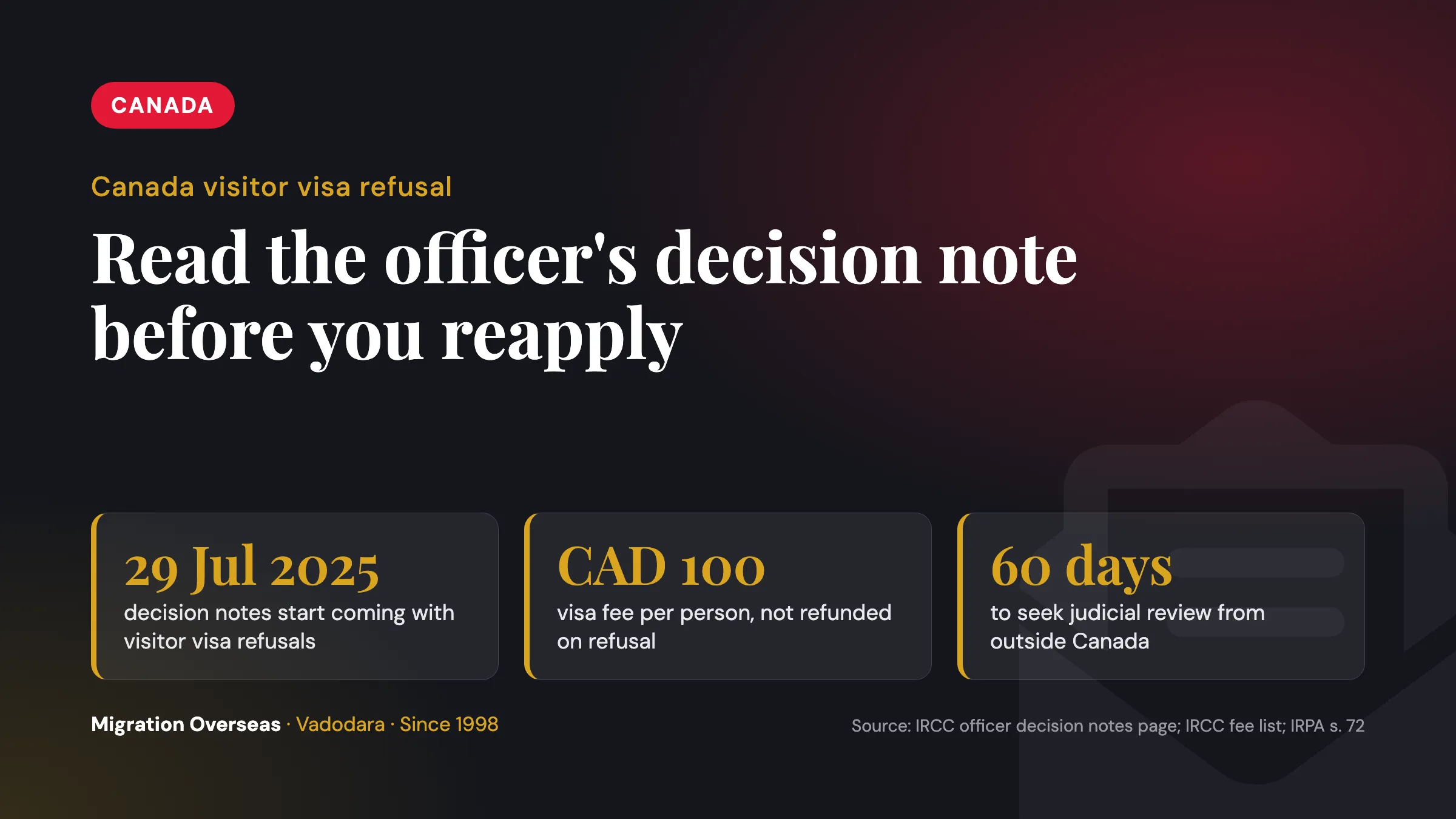
A Canada visitor visa refusal now comes with more explanation than it did a few years ago. Since 29 July 2025, Immigration, Refugees and Citizenship Canada (IRCC) has sent an officer decision note with refusal letters for temporary residence applications, including visitor visas, super visas and transit visas. In October and November 2026 IRCC also updated its help pages on refusals, and the message on all of them is the same: a second application with the same information will likely be refused again, the fee is not refunded, and hiring a representative does not by itself change the outcome. This post is for applicants in India, most often parents and siblings planning to visit family in Canada, who have a refusal in hand and need to decide what to do next. It covers how to read the letter and the note, when a fresh application makes sense, what counts as new evidence, and when it is better to wait or take a different route.
Key Takeaways
- Start with the reasons: the refusal letter names the section of the law the officer relied on, and the decision note, where one is included, explains the officer's reasoning.
- No waiting period: you may apply again at any time unless your letter says otherwise, but IRCC says repeating the same application will likely bring the same result.
- Change something real: a second application needs new documents that answer the stated concerns, or a genuine change in your purpose, job or finances.
- No appeal: visitor visa refusals cannot be appealed. If the decision was unfair or unreasonable, the remedy is judicial review in the Federal Court, filed within 60 days for a decision made outside Canada.
- Fees are lost on refusal: CAD 100 per person (CAD 500 maximum for a family of five or more applying together), plus CAD 85 for biometrics where required.
- Protect your record: an omission or an altered document can lead to a misrepresentation finding and five years of inadmissibility, which is far worse than a refusal.
What a Canada Visitor Visa Refusal Letter Tells You
The refusal letter is short, and that is why it is often misread. IRCC's guidance says the letter gives the reason for the decision and, in most cases, ties that reason to a specific section of the Immigration and Refugee Protection Act (IRPA) or its Regulations (IRPR). Before you do anything else, find that section and the wording next to it.
The section you will see most often is IRPR section 179. It lists the conditions an officer must be satisfied of before issuing a temporary resident visa, and paragraph (b) is the one that sinks most visitor files: the officer has to be convinced that you will depart by the end of the period you are allowed to stay. The same test appears in IRPA section 20(1)(b). Section 22(2) of the Act adds that wanting to settle in Canada one day does not by itself disqualify you, as long as the officer accepts that you will go home once this visit is over. That matters for parents whose children are already permanent residents and who may one day be sponsored.
IRCC groups refusals into four broad types: you did not meet an eligibility requirement (for example, enough money for the trip, or documents that are authentic and reliable); the officer was not satisfied you would leave or follow the conditions of your stay; the officer found false information or documents; or you may be inadmissible on grounds such as criminality, health or security. The table below sets out how these usually read in practice and what kind of evidence answers each one.
| What the letter or note points to | What the officer was not satisfied about | What would answer it |
|---|---|---|
| Purpose of visit, or a visit "inconsistent with a temporary stay" | Why you are going, for how long, and whether the plan fits your situation | A specific itinerary, a stay length that fits your leave or retirement, an event with a date (a wedding, a graduation, a birth) |
| Assets and financial situation | Whether you can pay for the trip and whether your money shows a settled life at home | Bank records over several months, income tax returns, pension or business records, and an explanation for any large recent deposit |
| Ties to India and leaving at the end of the stay (IRPR 179(b)) | What brings you back: work, family, property, responsibilities | Employer leave letter with a return date, proof of property or business, family members who stay in India |
| Documents not authentic or reliable | Whether a document is genuine, or whether its details match the rest of the file | Original-source documents that can be verified, and forms that match the documents exactly |
| Misrepresentation (last sentence of the letter) | A false statement, an altered document or a material omission | Usually not a reapplication; see the section on when not to reapply |
| Inadmissibility (criminal, medical, security) | A legal bar, not a weak file | The bar has to be dealt with first, for example through criminal rehabilitation |
The labels IRCC itself mentions in its refusal guidance include "Inconsistent Purpose", "Inconsistent with a temporary stay" and "Assets". When you see one of these, the problem is rarely a single missing paper. It is that the file, read as a whole, did not tell a believable story about a short visit followed by a return home.
The Officer Decision Note, and When You Still Need Your File
For temporary residence applications decided since 29 July 2025, IRCC sends a decision note with the refusal letter. The note is written by the officer who made the final decision and explains why the application was refused. IRCC says some portions may be removed where they contain sensitive information. The note goes to the applicant or to the authorised representative on the file. It covers visitor visas, super visas, transit visas, visitor records, study permits and work permits, though not electronic travel authorisations or temporary resident permits. Since 26 May 2026 permanent residence refusals receive notes as well.
Read the note line by line against your application. Officers usually state what they looked at and what was missing: a bank balance without a history, a purpose that did not match the stay requested, a lack of employment evidence. Each line is a concern you can answer, or a sign that you cannot answer it yet.
Requesting your full file
The decision note is not the complete record. If you received no note, if the note is a single generic line, or if you believe a document was misread, you can ask for your file, which includes the officer's notes in IRCC's case system. IRCC describes two routes:
- Privacy Act request: free, and open to foreign nationals wherever they are located. For an applicant living in India, this is the route the official pages describe.
- Access to Information Act request: CAD 5, and only Canadian citizens, permanent residents or people and companies present in Canada may make it. A relative in Canada can request your file this way with your signed consent on form IMM 5744.
Both are made through the government's ATIP online request service. IRCC has 30 days to respond to a formal request and may extend that period in cases the law allows, with notice. If you are considering judicial review, IRCC's page on decision notes adds a point many applicants miss: tell the court you have not received the reasons, even if you have a note, so the court can ask IRCC for the full reasons under its rules.
When Reapplying After a Visitor Visa Refusal Makes Sense
IRCC's position is plain. There is no waiting period before applying again, unless your decision letter says you cannot. But a new application should go in only if you can include information you did not include before, or if your situation has changed. IRCC's own examples of a relevant change are a different purpose for the visit, a change in your employment or financial situation, an approved criminal rehabilitation, and a medical reason that no longer applies. Its refusal guidance adds improved finances, a change in work or education, and new documents that address the officer's specific concerns.
Changes that can carry weight
- A purpose with a fixed date that did not exist before, such as a child's convocation or a family wedding, with proof of the event.
- A new job, a promotion or a business that now shows regular income in tax returns, not just a larger balance.
- Evidence that answers the note directly: if the officer doubted your return, an employer letter confirming approved leave and your return date; if the officer doubted your funds, statements that show how the money was built up.
- A visit plan that fits your life, for example two to four weeks for someone in salaried work rather than a six-month stay with no explanation.
Changes that rarely help
- The same file with a fresh cover letter or a consultant's letterhead. IRCC states that using a representative does not increase the chance of approval and brings no special attention or faster processing.
- A large deposit made into a bank account just before applying, with no explanation of where it came from.
- A longer invitation letter from a relative in Canada that repeats what the first one said.
- More pages of the same kind of document. Officers look for consistency between the forms and the documents, not volume.
A refused application keeps its fee, so every attempt costs money. IRCC's paper guide says biometrics are given once every 10 years, and a visa cannot be valid beyond 10 years from your last biometrics, so a second application soon after a refusal will often not need fresh biometrics. Check what the online application asks for before you pay.
When Not to Reapply Yet
Some refusals should not be followed by a quick second attempt.
- A misrepresentation finding. If the last sentence of the letter says you are inadmissible for misrepresentation, IRPA section 40 applies. A finding made outside Canada keeps you inadmissible for five years. IRCC's guidance notes that an omission can count even if it was unintentional, and that mistakes made by a representative are still your responsibility. This is a matter for legal advice, not a new form.
- Inadmissibility on criminal or medical grounds. The bar has to be overcome first, for example through criminal rehabilitation, before a new visitor application can succeed.
- A letter that says you cannot apply again for a stated period.
- A decision you believe was wrong in law or unfair. If, for example, the officer ignored a document you did submit, judicial review may be the right step. The 60-day limit runs from the date you were notified of the refusal, and a fresh application does not pause it.
- Several refusals on the same profile. Each refusal is part of your history and later officers can see it. If nothing has changed since the last one, a third or fourth attempt adds to the record without adding a reason to approve.
Be careful who you pay
Nobody can guarantee a Canadian visa, and IRCC warns against anyone who promises approval, suggests leaving out information or adjusting documents, or claims that a second application will succeed because they are filing it. Paying for invented bookings, fake employment letters or borrowed bank balances risks a misrepresentation finding and a five-year bar. If you use a paid representative, check that they are authorised under IRCC's rules.
Reapply or Go to the Federal Court
Under IRPA there is no appeal for a temporary residence refusal. The Immigration Appeal Division hears family-class sponsorship appeals, not visitor visas. What you can do, if the decision was unreasonable or the process unfair, is apply to the Federal Court for leave and judicial review under section 72 of the Act: within 15 days for a decision made in Canada and 60 days for one made outside Canada.
The two routes answer different problems. Judicial review asks whether the officer decided this file properly; the court does not grant the visa, and if you succeed the application usually goes back to IRCC for a fresh decision. A reapplication asks a new officer to decide a better file. When the original file was thin, reapplying with stronger evidence is usually quicker and cheaper. When the file was strong and the officer overlooked it, review can be worth the cost and time. Our guide to Federal Court judicial review of an IRCC refusal explains that process, timelines and costs in detail.
For Applicants From India
Many of the refused visitor files we review in Vadodara come from parents visiting a son or daughter who works or studies in Canada, or from families travelling for a wedding or a convocation. A few patterns come up again and again.
- The inviter's side is thin. IRCC's guidance on invitation letters asks the person in Canada to give their full details, their relationship to you, the purpose and length of the visit, where you will stay, who pays, when you plan to leave, their job and their status in Canada with proof. A letter of one or two lines rarely helps. It also does not guarantee a visa; it supports a file that must stand on its own.
- Funds without a history. In many Gujarati families money is held across a joint household, an HUF account, agricultural land or a family business. That is normal, but the officer needs to see it: tax returns, land records, business registration and several months of statements, with a short explanation of who owns what.
- Retired parents with no stated anchor. If you are retired, show what keeps you in India: a pension, property, other children or relatives who depend on you, and the length of the stay you actually need.
- Inconsistent dates and names. Travel history, employment dates and family details must match across the forms, the passport and the invitation letter. A mismatch can be read as unreliable documents.
- A stay too long for the stated purpose. If the plan is to help with a new baby for several months, say so, and show why you will return. If you want to visit for long periods every year, the super visa for parents and grandparents may be the better route; our post on the 2026 super visa income rules covers what it needs.
On cost, the CAD 100 visa fee and the CAD 85 biometrics fee come to roughly INR 6,000 to 6,500 and INR 5,000 to 5,500 at an exchange rate of about INR 60 to 65 per Canadian dollar, so check the rate on the day you pay. For a couple applying together, the government fees alone come to CAD 370 (two visa fees and the CAD 170 family biometrics maximum), about INR 22,000 to 24,000, before the visa application centre's own service charge, courier and any translation. For more general refusal patterns across countries, see our visa rejection reasons guide.
Our Reading
The decision notes have made the reapplication question more honest. Before July 2025, most applicants in India received a letter listing broad grounds and had to guess, or wait weeks for their file. Now most can see the officer's actual concern within the same message. I think that should change how people respond to a refusal: the first step is to read the note and ask whether the concern can be answered with something real, not to refile within days.
Who should reapply: applicants whose note points to a gap they can genuinely fill, such as funds that need a clearer history, an employer letter that was missing, or a purpose that now has a firm date. Who should wait: anyone whose circumstances are the same as when they were refused, and anyone with a misrepresentation finding or an admissibility problem. Who should think about the Federal Court: applicants whose file was strong and whose note shows the officer overlooked or misread key evidence.
I would also take IRCC at its word on representatives. A consultant cannot make an officer approve a file. What good advice can do is help you read the note correctly, decide whether to reapply, request your file or seek review, and present the evidence that actually answers the concern.
Your Action Checklist
Read the letter and the decision note together
Note the section of the law cited and list every concern the officer wrote down. Check whether the last sentence mentions misrepresentation.
Mark the 60-day date
If you think the decision was wrong or unfair, take advice on judicial review before the limit runs out. A new application does not stop the clock.
Request your file if the note is thin
Make a free Privacy Act request through the ATIP online service, or ask a relative in Canada to make an Access to Information request with your IMM 5744 consent.
Answer each concern with new evidence
Match every line of the note to a document or a real change. If you cannot answer a concern yet, wait until you can.
Check the whole file for consistency
Dates, names, employment and travel history must match across the forms, the passport and the invitation letter before you pay the fee again.
Visitor visa refused and unsure what to do next?
Our team in Vadodara reads refusal letters and decision notes for families across Gujarat and tells you plainly whether to reapply, request your file, seek review or wait. See our Canada visitor visa page for the full process.
Visitor Visa ServicesFrequently Asked Questions
Can I reapply after a Canada visitor visa refusal?
Yes. IRCC sets no waiting period unless your refusal letter says you cannot apply again. It advises applying again only if you have new information or documents that address the reasons for the refusal, or your situation has changed, because the same application will likely be refused again.
How long should I wait to reapply for a Canada visitor visa?
There is no fixed waiting period. The right time is when you can answer the officer's concerns, for example once you have an employer leave letter, a clearer financial history or a dated event to attend. Reapplying within days with the same documents rarely helps.
What is an officer decision note from IRCC?
It is a note written by the officer who refused your application, explaining the reasons. IRCC has sent decision notes with refusal letters for visitor visas, super visas, transit visas, study permits and work permits since 29 July 2025, and for permanent residence refusals since 26 May 2026. Some portions may be removed.
Can I appeal a Canada visitor visa refusal?
No. There is no appeal for temporary residence decisions. If you believe the decision was unreasonable or unfair, you can apply to the Federal Court for leave and judicial review within 60 days of being notified, for a decision made outside Canada.
How do I get my GCMS notes from India?
You can make a free request under the Privacy Act through the government's ATIP online request service; IRCC says foreign nationals may do this wherever they are located. A relative in Canada can instead make an Access to Information request for CAD 5 with your signed consent on form IMM 5744. IRCC has 30 days to respond, with extensions allowed in some cases.
Does hiring a consultant improve my chances after a refusal?
IRCC states that using a representative does not increase the chance of approval and brings no special attention or faster processing. Good advice can help you read the decision and present the right evidence, but the decision is the officer's.
Will I get my visa fee back if my visitor visa is refused?
No. Application fees are not refunded once processing has started, and IRCC warns that a reapplication with the same information may be refused without a refund. The visitor visa fee is CAD 100 per applicant, and biometrics cost a further CAD 85 where they are required.
What does misrepresentation in a refusal letter mean?
It means the officer found false information, an altered document or a material omission. Under section 40 of the Immigration and Refugee Protection Act, a finding made outside Canada makes you inadmissible for five years. Take legal advice before any further application.
Official sources
This article is based on IRCC's pages If your application for a visitor visa, work permit or study permit was refused, Explaining application refusals: officer decision note, My application for a visitor visa was refused. Should I apply again?, Do I have to wait before I apply again? and How do I get help if my temporary residence application is refused?; the IRCC fee list; How to apply for a visitor visa, Guide 5256 and Letter of invitation; IRCC's pages on requests under the Privacy Act and the Access to Information Act and its answer on response times; and the Immigration and Refugee Protection Act (sections 20, 22, 40, 63 and 72) and IRPR section 179. All were checked on 28 November 2026. Exchange rates and visa application centre charges are indicative only. It is general information, not legal advice.