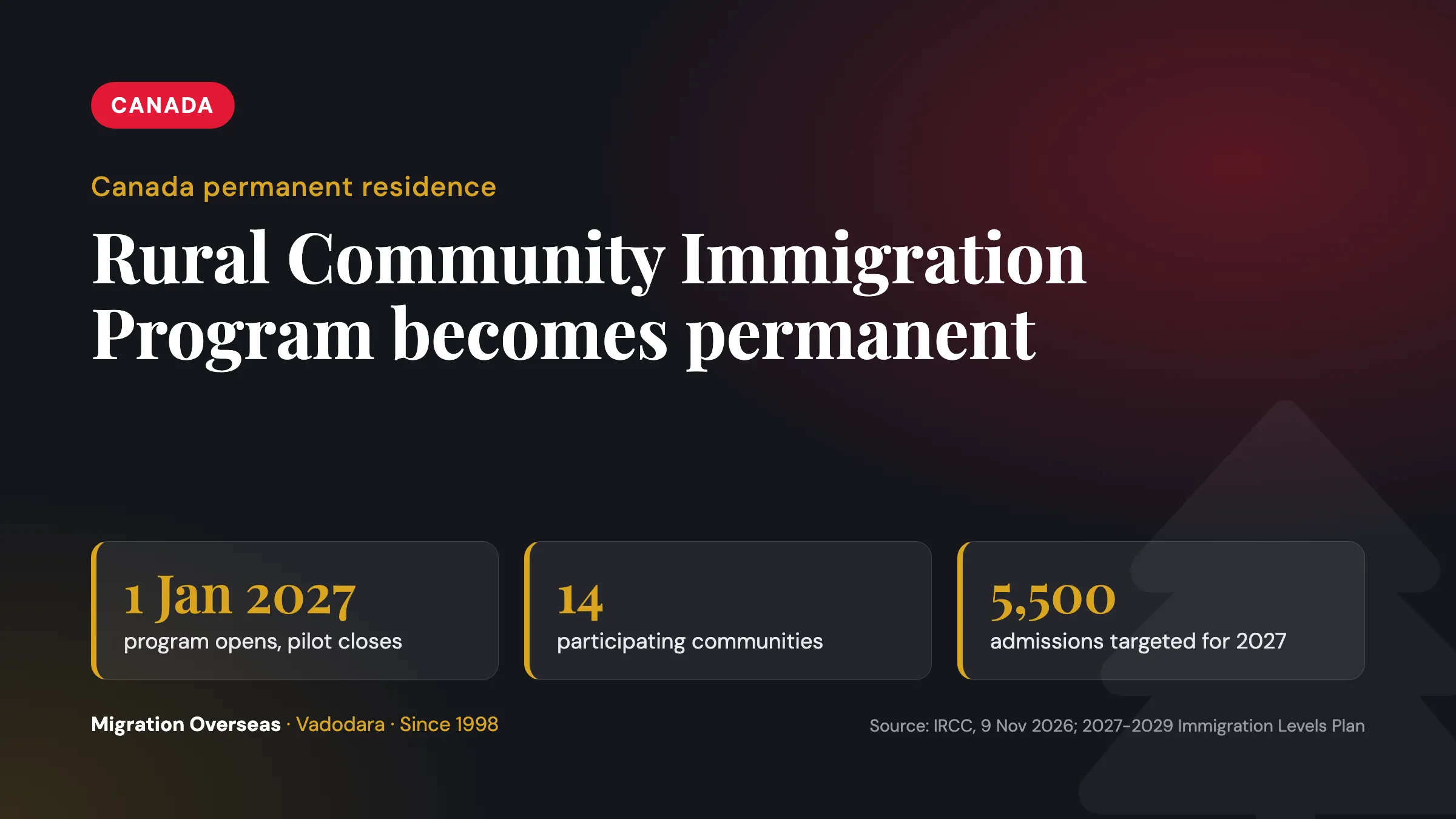
Canada's Rural Community Immigration Program becomes a permanent pathway to permanent residence on 1 January 2027. IRCC announced on 9 November 2026 that the rural pilot, which has run since January 2025, is being turned into a standing program, and that the 14 communities already taking part are expected to continue. On the same date the pilot closes to new community recommendations. The change matters to two groups: workers already in or near one of these towns, who now have a route that will not expire with a pilot, and applicants in India who are weighing rural Canada against Express Entry or a provincial nominee stream. This guide sets out what the permanent program requires, how the switch from pilot to program works in December and January, what it costs a family, and where we think it fits.
Key Takeaways
- Start date: the permanent program opens on 1 January 2027, and the pilot closes the same day. IRCC says it will keep processing pilot applications it has already received.
- Communities: 14 towns and regions in Nova Scotia, Ontario, Manitoba, Saskatchewan, Alberta and British Columbia. Expansion is planned, with criteria to come in a later announcement.
- Core requirements: a job offer from an employer the community has designated, a community recommendation, 1,560 hours of paid related work in the last three years, CLB 4 to 6 depending on the job, education proof and settlement funds.
- Numbers: the 2027 to 2029 levels plan targets 5,500 admissions in 2027, rising to notional targets of 6,000 in 2028 and 6,500 in 2029.
- No job offer, no application. There is no pool or draw. The route starts with a designated employer, which is also where most fraud attempts start.
What Changed on 9 November 2026
Canada has used community-driven rural immigration since the Rural and Northern Immigration Pilot, which ran from 2019 to 2024. IRCC says that pilot drew in more than 2,800 employers and led to the admission of more than 12,500 candidates and family members. Its successor, the Rural Community Immigration Pilot, started in 2025. Between January 2025 and August 2026, IRCC reports that communities designated more than 1,950 employers and issued more than 4,700 job offers and recommendations.
Pilots are temporary by design. They run under a ministerial instruction for a fixed period and can end, or change shape, at short notice. The 9 November announcement removes that uncertainty for the rural model. From 1 January 2027 it becomes the Rural Community Immigration Program, with its own application package and its own line in the levels plan. IRCC also says new communities will be added in future, and that the criteria for joining will be published separately. Its overview refers to communities with a population under 200,000 and a Statistics Canada remoteness index of 0.20 or higher as the profile it is looking for.
For applicants, the practical effect is that a job in a participating town now leads to a program that is expected to exist when your application is decided, not one that might close behind you.
The 14 Participating Communities
The permanent program is expected to start with the same 14 communities that ran the pilot. Each community runs its own website, publishes its priority sectors and lists its designated employers.
| Province | Communities |
|---|---|
| Nova Scotia | Pictou County |
| Ontario | North Bay, Sudbury, Timmins, Sault Ste. Marie, Thunder Bay |
| Manitoba | Steinbach, Altona/Rhineland, Brandon |
| Saskatchewan | Moose Jaw |
| Alberta | Claresholm |
| British Columbia | West Kootenay, North Okanagan Shuswap, Peace Liard |
Five of the 14 are in northern Ontario, which is worth knowing if you have relatives or a former employer there. The list also shows what the program is not: there are no large metropolitan areas on it, and the job must actually be performed in the community.
Rural Community Immigration Program Eligibility
The eligibility rules on IRCC's program pages carry over the structure of the pilot. You need all of the following when you apply for permanent residence.
A job offer and a community recommendation
The offer must come from an employer the community has designated. Designated employers post their vacancies on the community's site. Once you accept an offer, the employer, not you, submits the recommendation application to the community. The community checks that the job is in one of its priority sectors or occupations, that the offer is real and that you meet the program rules. If it agrees, you receive a recommendation certificate. IRCC's officer instructions for the rural route also say the offer must be full-time, year-round and with no end date, that at least 75% of the work must be done inside the community's boundaries, that the wage must be at or above the Job Bank range for that occupation in the region, and that you must intend to live in the community.
1,560 hours of related work in the last three years
That is one year of full-time work, but IRCC accepts other patterns that add up to the same hours, such as part-time work over two years or more than one job. The work must be paid. Volunteer work, unpaid internships and self-employment do not count. Your duties should match the main duties in the National Occupational Classification description for your occupation.
The experience does not have to be in the same occupation as the job offer, but it must sit at a related skill level:
| TEER of the job offer | TEER your experience can be in | Minimum language level |
|---|---|---|
| TEER 0 or 1 | 0, 1, 2 or 3 | CLB 6 |
| TEER 2 | 1, 2, 3 or 4 | CLB 5 |
| TEER 3 | 2, 3 or 4 | CLB 5 |
| TEER 4 | 2, 3 or 4 | CLB 4 |
| TEER 5 | Same five-digit NOC code only | CLB 4 |
There is one listed exception: experience as a registered nurse (NOC 31301) can support a job offer as a nurse aide or orderly (NOC 33102) or as a home support worker (NOC 44101). If you are unsure of your TEER, our guide to NOC 2021 codes explains how to match duties to a code.
The local graduate exemption
International students who graduate from a public post-secondary institution in the recommending community can skip the work experience requirement if they studied full-time in a program of at least two years, received the credential no more than 18 months before applying, and were in the community for at least 16 of the last 24 months of study. Graduates of a master's program of two years or less qualify if they studied full-time, received the degree within 18 months and stayed in the community for the whole program. Programs where more than half was language training or distance learning do not count, and neither do studies funded by a scholarship that requires you to go back to your home country.
Language, education and funds
- Language: English results can come from CELPIP-General, IELTS General Training or PTE Core, and French results from TEF Canada or TCF Canada. Results must be under two years old when you apply, and you must meet the minimum in all four abilities. For IELTS, CLB 6 means 5.0 in reading and 5.5 in writing, listening and speaking. Our CLB calculator converts the other tests.
- Education: a Canadian secondary or post-secondary credential, or a foreign credential with an Educational Credential Assessment (ECA) under five years old from a designated organisation such as WES or ICAS. Doctors, pharmacists and, where a licence is needed, architects need the assessment from their professional body instead.
- Settlement funds: CAD 10,507 for one person, CAD 13,080 for two, CAD 16,080 for three and CAD 19,524 for four, under IRCC's table updated on 29 July 2025. Your family size includes a spouse and dependent children who will stay behind in India. You do not need to show funds if you are already working in Canada on a valid work permit.
Never pay for a job offer or a recommendation
Communities vet their employers, and IRCC says designated employers must complete training and are monitored. No agent, recruiter or employer can sell you a designation, a recommendation or a place in the program. A "rural PR package" that includes a job offer for a fee is a warning sign, and false documents in a PR application can lead to a finding of misrepresentation and a bar on reapplying. Our checklist for spotting fake Canadian job offers applies directly here.
Pilot to Program: The December and January Switch
The date on your community recommendation decides which rules and forms you use. This is the part of the announcement most likely to catch people out.
| Your situation | What IRCC says |
|---|---|
| Pilot PR application already submitted | IRCC will keep processing it. You can still apply for the optional work permit if eligible. |
| Recommendation dated 31 December 2026 or earlier, PR not yet filed | Apply under the pilot package (IMM 0246 to IMM 0249) before the recommendation expires. |
| Recommendation dated 1 January 2027 or later | Apply under the new program package, which includes IMM 0301 (document checklist), IMM 0302 (offer of employment) and IMM 0299 (Schedule 1). |
| Job offer in hand, no recommendation yet | The recommendation will now be issued under the permanent program unless the community issues it before year end. |
IRCC's pages do not state how long a recommendation stays valid, and the only deadline wording for pilot holders is "before it expires". Check the expiry date printed on your certificate and the community's own guidance, and do not assume a holiday-season delay will be accommodated. A file on the wrong package is the kind of avoidable error that leads to a return or refusal.
Admission Targets and What They Mean
These figures come from IRCC's supplementary tables for the 2027 to 2029 levels plan, which we covered in our levels plan analysis. Two details matter. First, the rural line includes remaining applications from both earlier rural pilots, so not every 2027 space goes to new program applicants. Second, the 2028 and 2029 figures are provisional, and IRCC reviews them in each annual plan.
For scale, the Atlantic Immigration Program, which works on a similar employer-led model, has a target of 6,000 for 2027. The rural program is therefore comparable in size to a well-established federal route, but it is small next to Express Entry or the Provincial Nominee Program, and the spaces are spread across 14 local job markets.
Costs for a Family Applying From India
Government fees for permanent residence are the same as for other economic programs. The figures below are from IRCC's fee list as modified on 10 November 2026.
| Item | Official fee (CAD) |
|---|---|
| Principal applicant, including right of permanent residence fee | 1,590 |
| Spouse or partner, including right of permanent residence fee | 1,590 |
| Each dependent child | 270 |
| Biometrics | 85 per person, 170 maximum per family |
| Optional work permit (principal applicant) | 155 |
| Spouse's open work permit | 155 plus 100 open work permit holder fee |
For a couple with two children, the government fees for PR come to CAD 3,720 plus CAD 170 for biometrics, and the settlement funds requirement is CAD 19,524. On top of that, budget for the language test, the ECA, medical exams, police certificates and flights. Convert each amount to rupees on the day you pay, since the exchange rate moves.
Where Indian applicants trip up
- Experience letters from Indian employers often list a job title but not duties, hours and pay. IRCC asks for dates, duties, hours per week, salary and contact details. Get this right before the employer in Canada starts the recommendation.
- Funds held in family names. IRCC expects the settlement funds to be in your hands at the time you apply and again when the PR visa is issued. Money in a parent's account does not show that.
- The ECA's age. An assessment done for a student visa years ago may be over five years old by the time you apply.
- Name spellings across passport, degree, ECA and experience letters, which is a common issue with Gujarati names.
The Optional Two-Year Work Permit
Once you have applied for PR, you may be eligible for a two-year work permit tied to the designated employer who made the offer. You need the job offer, the community recommendation and to meet the general work permit rules, and the employer must give you an offer of employment number first. Your spouse or common-law partner can apply for an open work permit at the same time, but it is valid only in the same community. This lets a family move and start work while the PR application is processed. It also means the principal applicant's job is the family's only route in, which is worth thinking about before you resign from work in India. For how spousal permits work under other routes, see our spousal open work permit guide.
Our Reading
Making the rural route permanent is a sensible change. The pilots showed that small communities can choose employers carefully and keep newcomers, and a program with a future gives employers a reason to invest in hiring from abroad. For applicants, the main gain is predictability: you can plan a move to Sudbury or Brandon without wondering whether the pilot will still exist when your file reaches an officer.
The trade-offs are real, though. There is no CRS score to improve and no draw to wait for. Everything depends on one employer in one town agreeing to hire you, and on that town's priority list. In our experience, files on rural routes tend to be strongest when the applicant is already working or studying in the community, or has a credible link to the employer. Applicants applying cold from India for a TEER 4 or 5 job should be realistic: these employers receive many applications, and a job offer is hard to obtain from abroad without a genuine connection.
Who it suits: skilled tradespeople, health care and personal support workers, food processing and manufacturing workers, truck drivers and others with 1,560 hours of documented paid experience and CLB 4 to 6, especially those with a CRS score too low for Express Entry. Who should look elsewhere: anyone who would not live in a small, cold town for several years, or who hopes to move to Toronto or Vancouver soon after landing. The program is built on an intention to settle in the community, and that intention is part of what the officer assesses. If you have a reasonable CRS score, compare this route with your Express Entry position and with the provincial routes in our PNP guide before you commit.
Your Action Checklist
Check your hours and TEER
Add up your paid experience in the last three years and match it to the TEER table above. Get detailed experience letters now.
Book the language test and ECA
Aim for the CLB level your target job needs in all four abilities, and make sure the ECA will be under five years old when you apply.
Search the 14 community job boards
Use each community's list of designated employers and priority sectors. Apply only through those employers, and never pay for an offer.
Watch the recommendation date
A recommendation dated by 31 December 2026 uses the pilot package; one dated 1 January 2027 or later uses the new program forms.
File PR, then the work permit
Prepare funds of CAD 19,524 for a family of four, apply for PR online, then decide whether the two-year work permit suits your family.
Have a Job Offer in a Rural Canadian Community?
Our team in Vadodara checks job offers, experience letters and recommendation timing for applicants across Gujarat, and compares the rural route with Express Entry and provincial options for your profile.
Permanent Residency ServicesFrequently Asked Questions
When does the Rural Community Immigration Program start?
The permanent program opens on 1 January 2027. The Rural Community Immigration Pilot closes on the same date, and IRCC says it will keep processing pilot applications it has already received.
Which communities are in Canada's rural immigration program?
The 14 communities expected to take part are Pictou County in Nova Scotia; North Bay, Sudbury, Timmins, Sault Ste. Marie and Thunder Bay in Ontario; Steinbach, Altona/Rhineland and Brandon in Manitoba; Moose Jaw in Saskatchewan; Claresholm in Alberta; and West Kootenay, North Okanagan Shuswap and Peace Liard in British Columbia.
Can I apply for the rural immigration program from India without a job offer?
No. You need a job offer from an employer the community has designated and a recommendation from that community before you can apply for permanent residence. There is no profile pool or draw.
What IELTS score do I need for the Rural Community Immigration Program?
It depends on the job. TEER 0 or 1 jobs need CLB 6, TEER 2 or 3 jobs need CLB 5, and TEER 4 or 5 jobs need CLB 4, in all four abilities. For IELTS General Training, CLB 6 means 5.0 in reading and 5.5 in writing, listening and speaking.
What are the settlement funds for the rural immigration program?
Under IRCC's table updated on 29 July 2025, CAD 10,507 for one person, CAD 13,080 for two, CAD 16,080 for three and CAD 19,524 for four. You do not need to show funds if you are already working in Canada with a valid work permit.
My community recommendation is dated December 2026. Which rules apply?
A recommendation dated 31 December 2026 or earlier falls under the pilot. You apply with the pilot package and must apply for permanent residence before the recommendation expires.
Can my spouse work in Canada under this program?
Once you have applied for PR and qualify for the two-year work permit, your spouse or common-law partner can apply for an open work permit at the same time. It is valid only in the same community.
Do I have to stay in the community after getting PR?
The program requires that you intend to live in the community that recommended you, and officers assess that intention when they decide the application. A file that shows no real plan to settle in the community is at risk of refusal.
Official sources
This article is based on IRCC's news release making the rural pathway permanent and its program overview (both 9 November 2026); the Rural Community Immigration Program pages, including eligibility, job offer and recommendation, permanent residence and work permit (modified 9 November 2026); the pilot page and pilot application page; IRCC's officer instructions on who can apply under the rural route; the supplementary information for the 2027 to 2029 levels plan (modified 5 November 2026); and the IRCC fee list (modified 10 November 2026). It is general information, not legal advice.